Last week we took a fairly whirlwind trip to Boise to get the lay of the land. I was worried that Fang wouldn't like the city, but he does--perhaps even more than I do. Yay! You can read his posts about our travels--which included a job interview for Fang--here: day 1, day 2, and day 3. I'm a bit embarrassed to say it's the first trip Fang and I have taken alone since Lucas was born, which made it pleasant in and of itself.
Our travel was made possible by my lovely sister-in-law, who left her beautiful Venice (California) home to stay in our squalid 1978 tract home for a few days and take care of Lucas. She's awesome!
We'll be living about five miles from the university, a bit farther out than I'd like, but still a bikeable distance when the weather is half-decent. Unlike Davis, Boise doesn't have a park or two within walking distance of every house, and when I look at a map of the city, it seems our neighborhood has a greater park paucity than most. It's a great house, but because it's a block from a major street and a freeway onramp, it's not a place we'd buy--but it will be OK to rent for a couple years.
We also landed Lucas a spot in a decent preschool, albeit one that doesn't admit students until August, at about the same time I begin work, so we'll need to entertain Lucas for a month while we're settling in and I'm putting together the final details for my courses.
There will be difficult adjustments. Lucas calls Boise "the faraway home," and he's very excited to be moving there. But his best friend here told Lucas he'll be moving with him to the faraway home, and we're having a hard time convincing Lucas otherwise.
Lucas pointed out yesterday that when we're in Boise, Davis will be "the faraway home." Indeed.
On the home front, we've begun packing in earnest, as our move is less than three weeks away. I've removed most of the art from the walls and have been busy patching up nail holes, packing up framed prints and paintings, and boxing up just about anything I figure we can live without for the next month. Because we finally have an address in Boise, we're now able to secure a mover, and we're getting estimates from three next week.
It's been a few years since we've moved, and about a decade since we changed towns, and I'm just now remembering what a PITA moving is. Moving across state lines makes things more difficult, as our health, auto, and renters insurance policies are California-specific.
My own work in the teaching center is winding down a bit. Between it being summer and my frequent faculty contacts knowing that I'm leaving, I'm finding myself putting out fewer little fires, which means I can move the reports I need to write to the front burner. I'm working up until just a day or two before we drive to Boise, which is a bit insane, I know, but it's all a carefully choreographed dance of enough time to finish up projects, paycheck timing, health insurance expiration, Fang's work responsibilities, and cleaning up the house for a walk-through with the landlord.
As you can see, things are relatively boring here. It's mostly a matter of taking care of bureaucratic stuff--phone, internet, cable, insurance, forwarding mail, etc.
To make things more, um, interesting, on Tuesday I have to respond to a jury summons--I'm hoping I don't have to go to the courthouse, as my doing so would be a waste of everyone's time. I'm not able to serve on a long trial, since I'm moving, and the fact that I've attended many a rally and community meeting against the county D.A. and to protest Ajay Dev's unfair trial might tip off the lawyers and judge that I'm doubtful about the quality of justice being meted out in the county's courts. Back in May, when I was first summoned, I tried to explain my moving situation to the nice person who answers the jury hotline, but the best she could do for me was postpone my service until after the school year rather than excuse me completely. Honestly, I'd be happy to serve on a jury, but I suspect I'm highly unlikely to make it onto a case.
What's happening in your neck of the woods?
Friday, June 25, 2010


Monday, June 14, 2010
On (my) place(s) in the American West
There was a time when meadow, grove, and stream,
The earth, and every common sight,
To me did seem
Apparell'd in celestial light,
The glory and the freshness of a dream.
I.
Two clicks away from a Google search for "poems about Idaho," you'll find "Requiem for Idaho," a poem by Ron McFarland that begins
II.
I have never really identified this way, but I suppose I am what people back East might call a Westerner. Aside from four months in Fredericksburg, Virginia and three months in Washington, D.C., I've lived all my life west of the Mississippi—four years in Iowa and the rest in California.
In reading guidebooks on Idaho, I'm beginning to realize I'm moving into what many consider the Real West, where it's not a good idea to be an interloper from California.
I am very much from California. Like five or six generations Californian. Even Fang, despite early inclinations to the contrary, has come to consider himself a Californian.
III.
I have several favorite poems about California. Robinson Jeffers's "Carmel Point," Amy Clampitt's "John Donne in California," and Garrett Hongo's "Mendocino Rose" come immediately to mind. Clampitt so captures the essence of a California meal in her lines
IV.
I've never been a big fan of Long Beach, where I was born and grew up. In All the King's Men, Robert Penn Warren calls Long Beach "the essence of California." Jack Burden, the narrator of the novel, spends a night in a hotel in Long Beach:
When I left Iowa, I wrote dozens of poems about how much I missed its fields, its oppressive unbroken sky.
I suspect when I leave here, I will finally write poems about California, which, despite my best attempts to the contrary, I have come to love.
V.
Even as I grow wistful about my life in California, I am optimistic about Idaho. I hear the whole state is lovely--I've only seen one city in it--and everyone I've met who lives in Boise is enthusiastic about it and is exceptionally nice. I'm going to learn the language of fast rivers rather than ocean and delta. I'll learn an entirely new history, one with familiar themes because my new place is, after all, in the West.
When state politics get in the way--as I know they will, as Idaho is one of the most conservative states socially and perhaps the most fiscally conservative--I need to put myself in mind of Wordsworth's meadow, grove, and stream apparelled in celestial light. I suspect I'll put my faith in the land, and I'm trying to get myself back into shape so that I can enjoy it on bike, foot, and horseback.
VI.
As I've muddled around over the past few months with what it means to teach history--or, more specifically, what it means for me, with my motley interdisciplinary background in literature and nature and culture, to teach history and practice history, and especially public and local history--I've been returning again and again to microhistories, to the usefulness of partiality and discontinuity and standpoint epistemologies. It's been so long since I've read a great, whiggish narrative of U.S. history that even if I wanted to, I'm not sure I could teach American history as such. And so I'm approaching my classes and my research as an archipelago, to borrow a term from Florike Egmond and Peter Mason.
And I suppose approaching history as archipelago--as a chain of distinct, heterogeneous islands created by similar disruptive and yet creative forces--makes sense to me because Idaho is but the latest island in my personal far-flung archipelago of the West--Long Beach, Grinnell, Davis, Iowa City, Boise. Because of my academic training, but also because I've lived the perambulatory academic life--I'm suspicious of unifying explanations. And maybe that's why this blog post has gone on for so long--there's nothing that makes it hang together except for my experience of the West, of that place Amy Clampitt described as
The earth, and every common sight,
To me did seem
Apparell'd in celestial light,
The glory and the freshness of a dream.
— Wordsworth, "Intimations of Immortality from Recollections of Early Childhood"
I.
Two clicks away from a Google search for "poems about Idaho," you'll find "Requiem for Idaho," a poem by Ron McFarland that begins
Out here, we don't talk about culture,and ends
we think we are. We nurtured Ezra Pound
who ran from us like hell
and never came back. You
never came at all. You
will never know how clever
we never are out here.
Our mythology comes down to a logger
stirring his coffee with his thumb.

II.
I have never really identified this way, but I suppose I am what people back East might call a Westerner. Aside from four months in Fredericksburg, Virginia and three months in Washington, D.C., I've lived all my life west of the Mississippi—four years in Iowa and the rest in California.

In reading guidebooks on Idaho, I'm beginning to realize I'm moving into what many consider the Real West, where it's not a good idea to be an interloper from California.
I am very much from California. Like five or six generations Californian. Even Fang, despite early inclinations to the contrary, has come to consider himself a Californian.
III.

I have several favorite poems about California. Robinson Jeffers's "Carmel Point," Amy Clampitt's "John Donne in California," and Garrett Hongo's "Mendocino Rose" come immediately to mind. Clampitt so captures the essence of a California meal in her lines
There will be wine,that I'm already missing artichokes, even as I have several growing in my backyard garden at the moment. I'm wistful for the sommelier who haunts the wine aisle at my favorite supermarket.
artichokes, and California
politics for dinner
IV.

I've never been a big fan of Long Beach, where I was born and grew up. In All the King's Men, Robert Penn Warren calls Long Beach "the essence of California." Jack Burden, the narrator of the novel, spends a night in a hotel in Long Beach:
That was why I came to lie on a bed in a hotel in Long Beach, California, on the last coast amid the grandeurs of nature. For that is where you come, after you have crossed oceans and eaten stale biscuits while prisoned forty days and nights in a stormy-tossed rat-trap, after you have sweated in the greenery and heard the savage whoop, after you have built cabins and cities and bridged rivers, after you have laid with women and scattered children like millet seed in a high wind, after you have composed resonant documents, made noble speeches, and bathed your arms in blood to the elbows, after you have shaken with malaria in the marshes and in the icy wind across the high plains. That is where you come, to lie alone on a bed in a hotel room in Long Beach, California. Where I lay, while outside my window a neon sign flickered on and off to the time of my heart, systole and diastole, flushing and flushing again in the gray sea mist with a tint like blood.The California I have known is polarized: first there is my parents' house--my family's block, really--in a 1920s suburb; avocado and orange trees in the backyards; the long, nearly waveless beach a few blocks from there; my old high school festooned with razor wire and, in my memory, the tension of the L.A. riots. And then there is the Sacramento Valley and Davis, where it's common to see chickens in the yards of 1970s tract homes, where when I walk Lucas to preschool I pass through a small vineyard, a tiny cherry orchard, and walk past redwood, fig, almond, and olive trees. Where black walnuts shade and litter the largest boulevard near us. Where there's more dust and yeast in the air than salt and brine. Where oleander seems a reasonable tree.
I lay there, having drowned in West, my body having drifted down to lie there in the comforting, subliminal ooze on the sea floor of History.
When I left Iowa, I wrote dozens of poems about how much I missed its fields, its oppressive unbroken sky.
I suspect when I leave here, I will finally write poems about California, which, despite my best attempts to the contrary, I have come to love.
V.

Even as I grow wistful about my life in California, I am optimistic about Idaho. I hear the whole state is lovely--I've only seen one city in it--and everyone I've met who lives in Boise is enthusiastic about it and is exceptionally nice. I'm going to learn the language of fast rivers rather than ocean and delta. I'll learn an entirely new history, one with familiar themes because my new place is, after all, in the West.
When state politics get in the way--as I know they will, as Idaho is one of the most conservative states socially and perhaps the most fiscally conservative--I need to put myself in mind of Wordsworth's meadow, grove, and stream apparelled in celestial light. I suspect I'll put my faith in the land, and I'm trying to get myself back into shape so that I can enjoy it on bike, foot, and horseback.
VI.
As I've muddled around over the past few months with what it means to teach history--or, more specifically, what it means for me, with my motley interdisciplinary background in literature and nature and culture, to teach history and practice history, and especially public and local history--I've been returning again and again to microhistories, to the usefulness of partiality and discontinuity and standpoint epistemologies. It's been so long since I've read a great, whiggish narrative of U.S. history that even if I wanted to, I'm not sure I could teach American history as such. And so I'm approaching my classes and my research as an archipelago, to borrow a term from Florike Egmond and Peter Mason.

And I suppose approaching history as archipelago--as a chain of distinct, heterogeneous islands created by similar disruptive and yet creative forces--makes sense to me because Idaho is but the latest island in my personal far-flung archipelago of the West--Long Beach, Grinnell, Davis, Iowa City, Boise. Because of my academic training, but also because I've lived the perambulatory academic life--I'm suspicious of unifying explanations. And maybe that's why this blog post has gone on for so long--there's nothing that makes it hang together except for my experience of the West, of that place Amy Clampitt described as
strenuous
huge, wind-curried hills, their green
gobleted just now with native poppies'
opulent red-gold, where New World lizards run
among strange bells, thistles wear the guise
of lizards, and one shining oak is poison.

Tuesday, June 08, 2010
Evolution
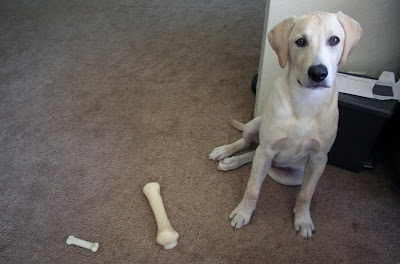
The bones nicely illustrate Jacob's rapid growth. He had a medium-sized bone, but he devoured it. Lesson learned: he needs the hardest Nylabones.

The revolution will be televised
I found this video to be particularly well done, and a nice review of a key, and tragic, moment in the Iranian protests. Please share it widely.
You can also upload a photo of yourself with the phrase "I am Neda" to NedaSpeaks.org, a project of Amnesty International. Here's mine:

You can also upload a photo of yourself with the phrase "I am Neda" to NedaSpeaks.org, a project of Amnesty International. Here's mine:

Saturday, June 05, 2010
By request: Puppy photos
Jacob is now just shy of five months old. I'm not really sure how this

became this

in just two months. And by the vet's estimate, at his current ~50 pounds, he's just over halfway to his adult weight.
I know I've been remiss by not posting a ton of cute puppy photos, but Jacob is difficult to photograph because he's so damn wiggly and is a whore for the camera. Most of my photos of him look something like this:

He does tend to hold a little more still for Fang, particularly when Fang is doing his back exercises:
 Really, he's adorable, alternately exuberant and kind of zen. I'll try to get some decent video of the cuteness to share with you all soon.

became this

in just two months. And by the vet's estimate, at his current ~50 pounds, he's just over halfway to his adult weight.
I know I've been remiss by not posting a ton of cute puppy photos, but Jacob is difficult to photograph because he's so damn wiggly and is a whore for the camera. Most of my photos of him look something like this:

He does tend to hold a little more still for Fang, particularly when Fang is doing his back exercises:
 Really, he's adorable, alternately exuberant and kind of zen. I'll try to get some decent video of the cuteness to share with you all soon.
Bats are fuzzy
Lucas and I went on a bat walk (really more of a drive) in the Yolo causeway last night. Here's the freeway bridge that connects Davis to West Sacramento:

The bridge has expansion joints that are perfect urban bat habitat. Our guide told me there can be 50 bats squeeze into a linear foot of expansion joint. The bats are tiny, as we learned in our orientation session:


Three photos above: Mexican free-tailed bat. Click to embiggen!

 Chomp! Nom nom nom.
 Above: Brown (very fuzzy) bat. The bats in these photos are captive because they have injured wings and aren't able to return to the wild. This particular brown bat has learned to love mealworms.
Just after sunset, the bats fly west from underneath the eastern end of the bridge, emerging to the south side of the bridge near this tree:

We saw three long ribbons of bats emerge, in waves about five minutes apart from one another. It was pretty spectacular. We're talking thousands and thousands of bats.
Definitely click to enlarge these sunset photos if you're into bats.
 If you live in this area, definitely sign up to take the bat walk and talk with the Yolo Basin Foundation. But hurry--all the spots are almost filled.

The bridge has expansion joints that are perfect urban bat habitat. Our guide told me there can be 50 bats squeeze into a linear foot of expansion joint. The bats are tiny, as we learned in our orientation session:


Three photos above: Mexican free-tailed bat. Click to embiggen!

 Chomp! Nom nom nom.
 Above: Brown (very fuzzy) bat. The bats in these photos are captive because they have injured wings and aren't able to return to the wild. This particular brown bat has learned to love mealworms.
 Just after sunset, the bats fly west from underneath the eastern end of the bridge, emerging to the south side of the bridge near this tree:

We saw three long ribbons of bats emerge, in waves about five minutes apart from one another. It was pretty spectacular. We're talking thousands and thousands of bats.
Definitely click to enlarge these sunset photos if you're into bats.
 If you live in this area, definitely sign up to take the bat walk and talk with the Yolo Basin Foundation. But hurry--all the spots are almost filled.
Wednesday, June 02, 2010
35
The director of the teaching center just pointed out that I share my birthday with the Marquis de Sade.*
Why does he know such things?
I'm 35 today. I'm enjoying making my coworkers feel old, even as I feel more 45 than 35.
Why does he know such things?
I'm 35 today. I'm enjoying making my coworkers feel old, even as I feel more 45 than 35.
Friday, May 28, 2010
Accessible Course Hacks: A Brief Primer
This is a last-minute submission for Hacking the Academy.
Because "disability" is an extremely slippery category, it's not easy to state what percentage of students on any given campus have a disability, but various studies have estimated that between 3 and 11 percent of undergraduate students enter college with some kind of disability. If we're including physical, learning, and emotional disabilities—both those students are aware of and those they are in the process of developing or identifying—I suspect the number is much higher.
So I'm puzzled when faculty members—and there have been many—say to me, "In all my years of teaching, I've never had a disabled student in my classes."
After all, if you're teaching a class of 300 students—and my university has classes that enroll upward of 900, so I'm being conservative here—and 10 percent of them have some kind of disability, you're looking at 30 students who right off the bat might need some kind of accommodation but might not ask for help.
Accommodating students is usually really easy once they ask for help. After all, in order to comply with state or federal laws, most universities have administrative or student-services units that work with students with disabilities to determine for which accommodations they're eligible and ensure they get the needed assistance. Often, the only time faculty hear about students' disabilities is when they receive a note from the student disabilities center informing them that certain students qualify for additional time on an exam. Such accommodations are ridiculously simple to provide.
I've found that it's very easy to accommodate students in other ways as well; it's usually not any additional work, and is in fact a matter of being cognizant and thoughtful. Let me use blind or low-vision students as an example. I arrive at my first class already having posted an accessible version of the syllabus online, and I have both standard and large-print versions of my syllabus available. When I've taught low-vision students, I simply need to remember to e-mail any handouts to them in advance of the class so that they can pull them up on their laptops with screen readers or transfer it to their Braille PDAs. I also am careful to describe any images or video I'm sharing with the class.
When I accommodate students with disabilities, many other students benefit. Drawing again on my examples above, any student might appreciate having a digital version of the syllabus handy. And if I e-mail class handouts to the entire class instead of just those students who have been cleared for accommodations, more students arrive ready to discuss the topic at hand because the handouts I send help to frame their understanding of the material they've read or viewed or listened to. In the case of images I'm projecting onto a screen during class, I frequently have students describe images to one another because they all—sighted or not—find new layers to an image when they discuss it with their peers. In fact, sometimes I'll pass out an image to a group, and only one person in each group gets to look at it at first—they have to describe it to the other students in the group, and the other students ask questions about it, which tends to deepen their understanding of what's going on.
There are dozens, and probably hundreds, of ways we can accommodate students with a variety of physical and learning disabilities, but the most important thing, I think, is that we adhere to principles of the universal design for learning as we develop our courses. To borrow a phrase from the disability movement, we need to "build in" such accommodations instead of "bolting them on" after the fact. Yes, there are certain things—like the amount of extra time a student should receive on an exam—that are best determined, out of fairness to all students, by experts who have documented the student's disability, but there are plenty of things we can do to accommodate students without having to worry about establishing an accidental legal precedent.
It can seem overwhelming at first, I know, but really it's about being mindful—double-checking, for example, that the blog platform or course management system you're using is accessible to all users—rather than about opening yourself up to a ton of additional work. One small step I typically take is not only to include a statement on my syllabus saying that I'd like to hear from students with disabilities, but also emphasize my interest in teaching all students by highlighting this section of the syllabus on the first day of class. Since I began making a bigger deal out of my desire to accommodate students with disabilities in simple ways, I've had greater numbers of students approach me for assistance, and they've never asked for anything unreasonable. Many of them end up going to student disability services for the first time ever to document a learning disability they have suspected for some time. I've taken a good deal of satisfaction in helping students better understand how they themselves learn, as well as in presenting them with resources they might use to explore the complexity of their various identities, including their status as people with disabilities.
Because "disability" is an extremely slippery category, it's not easy to state what percentage of students on any given campus have a disability, but various studies have estimated that between 3 and 11 percent of undergraduate students enter college with some kind of disability. If we're including physical, learning, and emotional disabilities—both those students are aware of and those they are in the process of developing or identifying—I suspect the number is much higher.
So I'm puzzled when faculty members—and there have been many—say to me, "In all my years of teaching, I've never had a disabled student in my classes."
After all, if you're teaching a class of 300 students—and my university has classes that enroll upward of 900, so I'm being conservative here—and 10 percent of them have some kind of disability, you're looking at 30 students who right off the bat might need some kind of accommodation but might not ask for help.
Accommodating students is usually really easy once they ask for help. After all, in order to comply with state or federal laws, most universities have administrative or student-services units that work with students with disabilities to determine for which accommodations they're eligible and ensure they get the needed assistance. Often, the only time faculty hear about students' disabilities is when they receive a note from the student disabilities center informing them that certain students qualify for additional time on an exam. Such accommodations are ridiculously simple to provide.
I've found that it's very easy to accommodate students in other ways as well; it's usually not any additional work, and is in fact a matter of being cognizant and thoughtful. Let me use blind or low-vision students as an example. I arrive at my first class already having posted an accessible version of the syllabus online, and I have both standard and large-print versions of my syllabus available. When I've taught low-vision students, I simply need to remember to e-mail any handouts to them in advance of the class so that they can pull them up on their laptops with screen readers or transfer it to their Braille PDAs. I also am careful to describe any images or video I'm sharing with the class.
When I accommodate students with disabilities, many other students benefit. Drawing again on my examples above, any student might appreciate having a digital version of the syllabus handy. And if I e-mail class handouts to the entire class instead of just those students who have been cleared for accommodations, more students arrive ready to discuss the topic at hand because the handouts I send help to frame their understanding of the material they've read or viewed or listened to. In the case of images I'm projecting onto a screen during class, I frequently have students describe images to one another because they all—sighted or not—find new layers to an image when they discuss it with their peers. In fact, sometimes I'll pass out an image to a group, and only one person in each group gets to look at it at first—they have to describe it to the other students in the group, and the other students ask questions about it, which tends to deepen their understanding of what's going on.
There are dozens, and probably hundreds, of ways we can accommodate students with a variety of physical and learning disabilities, but the most important thing, I think, is that we adhere to principles of the universal design for learning as we develop our courses. To borrow a phrase from the disability movement, we need to "build in" such accommodations instead of "bolting them on" after the fact. Yes, there are certain things—like the amount of extra time a student should receive on an exam—that are best determined, out of fairness to all students, by experts who have documented the student's disability, but there are plenty of things we can do to accommodate students without having to worry about establishing an accidental legal precedent.
It can seem overwhelming at first, I know, but really it's about being mindful—double-checking, for example, that the blog platform or course management system you're using is accessible to all users—rather than about opening yourself up to a ton of additional work. One small step I typically take is not only to include a statement on my syllabus saying that I'd like to hear from students with disabilities, but also emphasize my interest in teaching all students by highlighting this section of the syllabus on the first day of class. Since I began making a bigger deal out of my desire to accommodate students with disabilities in simple ways, I've had greater numbers of students approach me for assistance, and they've never asked for anything unreasonable. Many of them end up going to student disability services for the first time ever to document a learning disability they have suspected for some time. I've taken a good deal of satisfaction in helping students better understand how they themselves learn, as well as in presenting them with resources they might use to explore the complexity of their various identities, including their status as people with disabilities.
Thursday, May 27, 2010
More RBOC--and a PSA
. . .because that's all I have in me these days.
When you open your driver's side car door, please take a second to look over your shoulder to see if there's a bike coming up behind you. A good friend of mine from high school was killed last week when a driver opened her door right in front of him, which knocked him in front of, and under, a bus.
Additionally, if you drive on the right side of the road, look over your right shoulder before turning right. This is a little trick I've learned here in Davis, and it's averted many an accident, I assure you.
- I am feeling remarkably well this evening because I cleaned out a good deal of the garage, AKA my secret shame. We had barely touched it since we moved into this house more than three years ago, and there were some hurriedly packed boxes left untouched at that time, so you might imagine the dreck I was pawing through. Most of it was paper and went into the recycling bin.
- We're going to have an enormous yard sale. I hate holding yard sales, but the extra cash will be nice.
- Lucas decided that, since we only have about 50 days left before we move, he should grab the empty boxes from the garage and start packing up his toys. Now if only Fang could catch some of that enthusiasm. . .
- Fun fact: I have whooping cough. Ends up I've been contagious for at least a month. Sorry, coworkers--I thought it was merely bronchitis.
- If you haven't had a booster vaccine for whooping cough, you might want to get one, as pertussis is resurging. And for the love of all that is holy (breathing, for example), be sure your kids' vaccinations are up to date.
- I don't know how much longer it will be available to nonsubscribers, but my interview with the Sacramento Bee about the literature of Lost is available here on the Sac Bee site, and here as a PDF. My TV interview isn't online, but it was fun--and I managed to rope Fang into the fun as well, as he's much more articulate about Lost than I am. We got about equal screen time; Fang was a "local blogger" and I earned a promotion from the reporter--professor of cultural studies.
- I'm giving a teaching talk tomorrow for the Faculty Mentoring Faculty Program at UC Davis. It's called "The Undisciplined Instructor: Lessons on Teaching from Perpetual Amateur." If I don't embarrass myself too terribly, I'll post a link to the video for anyone who is looking for a soporific.
When you open your driver's side car door, please take a second to look over your shoulder to see if there's a bike coming up behind you. A good friend of mine from high school was killed last week when a driver opened her door right in front of him, which knocked him in front of, and under, a bus.
Additionally, if you drive on the right side of the road, look over your right shoulder before turning right. This is a little trick I've learned here in Davis, and it's averted many an accident, I assure you.

Thursday, May 20, 2010
RBOC: My Brain is Full edition
Long time, no blog.
I've been fighting off some kind of lung plague for three weeks now, and I haven't been feeling very bloggy. More nod-off-on-the-couch-and-watch-reruns-of-Bones-y. (Which, I might add: Why did no one ever tell me that the show is about a woman scientist working in a Smithsonian-like museum? Hello--that was my dissertation topic.) So instead of any semblance of sustained thought, I present a long-overdue random bullets of huh-huh-huh.
But first, a question: I'm supposed to give a talk about teaching next Friday, kind of a "last lecture" thing for a small audience of (usually senior) faculty. Typically speakers talk for 30 minutes and then take questions for 20. Number of times I've talked for 30 minutes straight in the past several years: 1. (Job talk. I'm chatty but not lecture-y.) This Faculty Mentoring Faculty Program presentation will be videotaped and made available online. What teaching topics would you want to hear about? Bonus points if you can describe the topic without using the words assessment, literacies, instructional technology, or student learning outcomes. Extra bonus points if you use the phrase rats off a sinking ship.
Now, the bullets:
I've been fighting off some kind of lung plague for three weeks now, and I haven't been feeling very bloggy. More nod-off-on-the-couch-and-watch-reruns-of-Bones-y. (Which, I might add: Why did no one ever tell me that the show is about a woman scientist working in a Smithsonian-like museum? Hello--that was my dissertation topic.) So instead of any semblance of sustained thought, I present a long-overdue random bullets of huh-huh-huh.
But first, a question: I'm supposed to give a talk about teaching next Friday, kind of a "last lecture" thing for a small audience of (usually senior) faculty. Typically speakers talk for 30 minutes and then take questions for 20. Number of times I've talked for 30 minutes straight in the past several years: 1. (Job talk. I'm chatty but not lecture-y.) This Faculty Mentoring Faculty Program presentation will be videotaped and made available online. What teaching topics would you want to hear about? Bonus points if you can describe the topic without using the words assessment, literacies, instructional technology, or student learning outcomes. Extra bonus points if you use the phrase rats off a sinking ship.
Now, the bullets:
- I was interviewed last week by a reporter for the Sacramento Bee. He grilled me about the literature of the TV show Lost. I blame my friend Dr. Andy, who handed over my cell phone number to the university news service when the folks there were looking for someone to comment on the show. The reporter's sole follow-up question was on the symbolism of rabbits on the show. I think I last used the word "symbolism" in 1998. Where are the English and cultural studies faculty when you need them? (I'll post a link to the interview when it's available. They asked for a photo of me, which is unsettling, as I thought I'd be one source among many, not the entire horse and pony show.)
- Tomorrow I'm talking to a TV reporter about Lost, but I'm not sure what about the show most interests him, other than that ZOMG the show is ending, how will fanfolk ever live without it? The reporter's first and last names are both those of nice East Coast colleges. If I were writing a short story about an English professor, I'd probably give him the same name.
- Dr. Andy tells me I should write an article or book about Lost. My first thought: Ooh, shiny! I then reminded him I'm about to launch onto the tenure track in history. Put down the contemporary pop culture references, Leslie. . .
- I remind myself that (ack!) I'm moving to Boise in less than two months and I have yet to sign a lease, line up movers, find a preschool, get health insurance, or do just about anything else. It's just a tad too early to do anything of these things because apparently everything in Idaho (except for sign-ups for the best preschools, whose deadlines have long since passed) happens at the last minute. "Show up with your stuff and then find a place," was how one property manager put it. "You can sign up on July 31st for health insurance on August 1st," enthused the insurance agent. Um, no. But if this is the case everywhere in the Gem State, I'm looking forward to my first trip to the DMV. (Though on a side note, I don't think any DMV could beat my trip to the Iowa City DMV. No lines, and they handed me new license plates within minutes.)
- What have I done thus far? Ordered my textbooks for fall. I made a lovely matrix to evaluate potential textbooks for my U.S. history survey to 1877, filled in several cells with details after browsing a dozen or more textbooks online, came up with my own "gut check" scoring system. . .and then threw a mental dart that landed, conveniently, on the one desk copy I've received from a publisher. What can I say? I like paper. (Plus, the textbook's writing didn't make me cringe. I learned the writing in many (most?) of today's history textbooks kind of sucks.)
- The department chair contacted me this week to let me know I don't need to teach one grad seminar and two lower-division courses in the spring. Instead I can teach one grad seminar and any upper-division course of my choosing, preferably one with a focus on gender. I'm thinking of tackling the capstone writing course for history majors. The class size is apparently pretty small, so I could give students' papers a good deal of individual attention. Your thoughts?
- We've had nothing but bad luck with trees lately. Our landlord sent out some apparently tree-hating in-law of his to trim our trees. We now have no cherry saplings, a fig tree trunk that protrudes about seven feet from the ground where there used to be a glorious sweeping fig tree, and the shoulder-height remains of a few 15-foot-tall oleander bushes in the backyard.
- Well, we thought, at least the neighbor's big, lovely, leafy cottonwood tree (my favorite species!) provides us with shade. I came home this afternoon to find the neighbors have completely removed the giant tree.
- I'm glad we're moving in July. Summer in Davis with no shade = unbearable.
- After months of working on it, I finished my first copyedit of Fang's 750-page novel. Yes, our next talk about it will be how to cut it by at least one-third. Can you say "trilogy"?
- Sometimes it bothers me that Fang is a much more prolific writer than I am. He made the good choice as a writer not to sweat through an M.A. in creative writing and a Ph.D. in mumblety mumble like some people you might know.
- Our puppy, Jacob, is getting big. He's about 45 pounds now--halfway to full grown. As puppies go, he's very manageable, despite his oafish size. Pictures soon, I promise.
Subscribe to:
Posts (Atom)